Welcome to my blog. You will find here some news and texts that come side by side to my artistic activities as choreographer, dancer and performer.

Friday, 4 June 2010

Czerwona Trawa at XXV Days of Contemporary Art

Teatr Dada von Bzdulow with Czerwona Trawa/Red Grass at XXV Days of Contemporary Art in Bialystok/Poland

Dada von Bzdülöw Theatre – founded by Leszek Bzdyl – a director and a choreographer, and by Katarzyna Chmielewska – a dancer and a choreographer; on stage since 1993; an independent group of professional dancers and actors, which produces performances in cooperation with Polish and foreign cultural institutions As of today, Dada have produced around 40 performances. Since 2008 the theatre is represented by Dada von Bzdülöw Artists Association with its seat in Gdańsk, Poland.

Dada von Bzdülöw Theatre works at the interface between acting and dance expression. It uses poetics of pure nonsense, the elements of trivial everyday life, high culture clashes with kitsch. It also builds the climate of its performances through handling light and colour.


Red Grass

A story about male-female relationships expressed by means of dance. It would seem that they are very complex; that there are subtle nuances between the sexes which hinder mutual understanding. Meanwhile, the game between lovers is always the same and determined by biologism.

After reading a book by Boris Vian reality is no longer the same. His surrealistic vision is so compelling and opening that one would like to stay there and last, despite the bitterness and unspecified sadness. Be like a Senator dog, who is missing only Łapiti to be completely happy, or as Lil, who has two specially trained beetles to give manicure, or to dance to Duke Ellington’s...

Katarzyna Chmielewska

1 - this is a book of my life (I’ve read it for the first time when I was 22 years old and somehow I identified with the Wolf, which probably influenced my attitude to the world for the next 22 years)
2 - if one loves something too much, one becomes blind and loses the distance
3 - we dance and do not talk, and yet the whole Vian’s charm is in the language, so we should find a similar charm in motion
4 - it results from what was mentioned above that we have to start with Vian and than flee from him and autonomically act in a self-fulfilling performance

Leszek Bzdyl

director: Katarzyna Chmielewska and Leszek Bzdyl
choreography and performance: Katarzyna Chmielewska, Tatiana Kamieniecka, Ula Zerek, Leszek Bzdyl, Radek Hewelt
music: Mikołaj Trzaska
stage design: Maciej Chojnacki
video: Kamila Chomicz / in video sequence: Cezary Rybiński
lights: Michał Kołodziej

production: Wybrzeże Theatre, Gdańsk; Dada von Bzdülöw Theatre
supported by the Government of the City of Gdansk.


Links:

http://www.dsw.bialystok.pl/program.html

Some photos from QUER: Symposium und Labor für Interkreativität

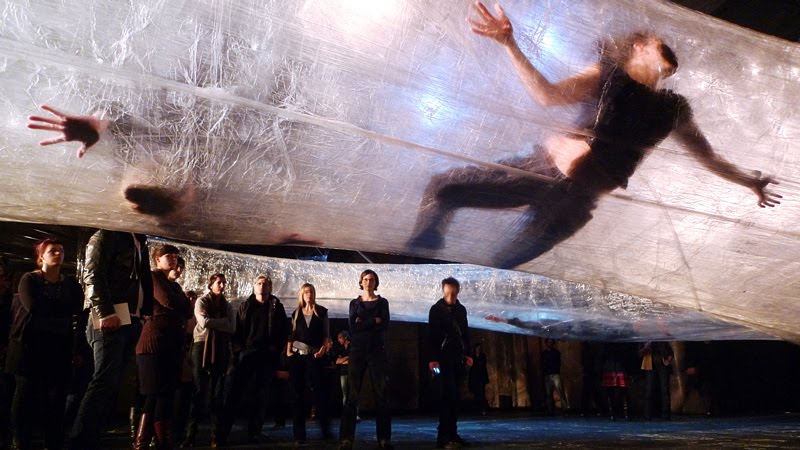
Between 11-13 March I participated in the interesting installation by numen/for use at Viennese Odeon. This installation was a part of QUER: Symposium und Labor für Interkreativität. Below I enclose some pictures from the event.


Links:
http://quer.departure.at
http://www.foruse.info/
http://radekhewelt.blogspot.com/2010/03/tape-installation-by-numenfor-use-and.html

Tuesday, 25 May 2010

At corpusweb.net: Radek Hewelt "WITH “HOW?” ON STAGE"

Lately published at corpusweb.net
http://www.corpusweb.net/radek-hewelt.html


RADEK HEWELT

WITH “HOW?” ON STAGE

In this text I’m going to concentrate on my group works. My solo projects usually have a different character and artistic output. I’d like to begin by announcing that I’m not a visionary. It’s a very rare situation that I see a clear picture of what the work will look like in the end. I have some ideas about the direction, frame, colors, shapes, background, etc., but it’s the process of development in the “laboratory” that makes a final image appear.

FOCUS ON PHYSICALITY AND THE STATE OF THE BODY

Most of my works are characterized by a strong focus on the body. Even if text and vocal expression are present they are always in strong relation with physicality. A body state derives from the theme of a particular work. For instance, in “CLOSE-UP” a dance came out of body response to a topic of intimacy. The physical language was constructed through observation, analysis, embodiment and deconstruction of the human body in a situation of affection. In this context I can’t imagine a process without creating an intimate and trustful situation in the studio that allows people I work with to openly interact, experiment and search. I try to create a specific universe in which the final picture is born out of our dialogs, sensitivities, qualities and capacities.

LANDSCAPE BETWEEN CONCRETENESS AND ABSTRACTION

I start each project with a more or less concrete interest or question. My latest works were circulating around topics like intimacy, public - personal distance, relation between physicality and voice, how to bring the effect of close-up on stage, etc. Those themes lead to the definition of the field that the dancers are going to operate in. It usually takes quite some time to draw the borders and inhabit this particular land. Then out of “living” in this place we create the material that ranges from everyday action to abstract forms. In the process of developing a homogeneous body language of a particular piece sooner or later we are confronted with two questions: how to abstract the narrative forms and how to give a meaning to abstract forms? I try to find the answers through the process of developing a particular stage presence.

STAGE PRESENCE

I’m usually not interested in action as a 100% narrative or abstract momentum but in its execution. For instance if a dancer touches the wall my focus wouldn’t lie on the act of touching as a narrative action or a detached abstract movement but in the way how one does it. Therefore the laboratory work during the creation is so important in my work. It generates the strategies how to “live” the forms and actions on stage. Those strategies derive from concentrating on different systems of stimuli coming from body, senses, emotions, imagination, musicality, interactions with partners, etc. They can be abstract or very concrete. During the performance a dancer is occupied with forms and tasks that are filled out with information coming from the activation of the whole sensing system. The meaning or fill-out of specific actions has to be clear for a performer but not necessarily for the spectator. At the end the audience is confronted with the dancers “living” their choreographies on stage.

ARTISTIC OUTPUT, STRUCTURE AND STAGE DESIGN

The universe that my collaborators and I inhabit for the time of the creation and the theme of the work are reflected by the performers' physical response to it and their specific stage presence which I described above. But also the performance's structuring and stage design play a significant role in the communication with the audience in my works. They create a context for the dance and determine the directions of reading it. For example in “ZOOM IN”, which explored the topic of affection by way of shifting between public and personal distance, the stage was situated in the corner of a rather small room. The squeezed-in public sat close to the dancers and had two more walls just behind their backs. During the piece the performers were consequently approaching the spectators and finally crossed the border between stage and audience. The people watching the performance were recorded by a hidden camera, and at the end they could see themselves reacting to the show on a video projection in the adjacent room. Though the structure and stage design are very important, they do not give any answers, and their main function is to emphasise the “HOW?”

Sunday, 28 March 2010

Czerwona Trawa/Red Grass again at Teatr Wybrzeze in Gdansk

After succeesful performance in Olsztyn last weekend Teatr Dada von Bzdulow will perform Red Grass again at Teatr Wybrzeze in Gdansk on 31th March and 1st April. I have a pleasure to be a part of this performance. We'll perform in a city I come from so it's always an emotional experience for me.


Artistic Direction: Leszek Bzdyl, Katarzyna Chmielewska

Performing: Katarzyna Chmielewska, Tatiana Kamieniecka, Anna Steller (substituting Ula Zerek), Leszek Bzdyl, Radek Hewelt

Music: Mikolaj Trzaska

Scenography & Costumes: Maciej Chojnacki

Video: Kamila Chomicz


Boris Vian, one of the soul fathers of Teatr Dada von Bzdulow, comes back in this project of a group. In its 16-years long history Teatr Dada had already twice created the works inspired by this french writer.

In Czerwona trawa/Red Grass Teatr Dada von Bzdulow meets again a prose of Boris Vian. Multidimensional language of dance theatre is a good starting point for a creative tryout of interpretation of Vian's writings in which he vies with subjects like life, youth, senility, love and death.


More informations about the show in Teatr Wybrzeze:
http://www.teatrwybrzeze.pl/#/spektakle/czerwona-trawa/2010-03-31

Thursday, 25 March 2010

Teatr Dada w Olsztynie/Theatre Dada in Olsztyn


Theatre Dada von Bzdulow will presents its creation "Red Grass" within XVIII Olsztyn's Theatre Meetings on Saturday 27th March. A performance will be shown at the Theatre of Stefan Jaracz.


CZERWONA TRAWA/RED GRASS
inspirowana powiescia/inspired by a novel by Boris Vian

reżyseria/artistic direction: Katarzyna Chmielewska, Leszek Bzdyl
scenografia/scenography: Maciej Chojnacki, muzyka/music: Mikołaj Trzaska, video: Kamila Chomicz /w sekwencji video/in video sequence: Cezary Rybiński/, reżyseria świateł/light design: Michał Kołodziej

choreografia i wykonanie/choreography and performance: Katarzyna Chmielewska, Tatiana Kamieniecka, Anna Steller, Leszek Bzdyl, Radek Hewelt


Fragmenty recenzji z teatralia.com.pl Alicji Olkowskiej/Fragments of the review from teatralia.com.pl by Alicja Olkowska (just in polish)


Katarzyna Chmielewska: Po przeczytaniu jakiejkolwiek książki Borisa Viana, rzeczywistość nie jest już taka sama. Jego surrealistyczna wizja jest tak pociągająca i otwierająca, że chciałoby się w niej przebywać i trwać, pomimo goryczy i bliżej nieokreślonego smutku.
— Najnowsze taneczne dziecko Teatru opowiada o relacjach damsko - męskich. Wydawać by się mogło, że są one mocno skomplikowane, że trudno zrozumieć kobiety i mężczyzn, że między płciami zachodzą subtelne niuanse, które utrudniają zrozumienie zaangażowanych stron. Okazuje się, że relacje te są niezwykle proste, a wręcz łatwo przewidywalne, gyż gra między kochankami jest zawsze taka sama zdeterminowana przez biologizm.
Zaczyna się niewinnie. Ot, zwykła dyskoteka /.../. Na podświet-lonym parkiecie prowadzą taneczny flirt dwie pary. Tańczą, uśmiechają się do siebie, patrzą na siebie tak, że wiadomo do czego każdy ich krok zmierza. Udało się! Mężczyźni rzucili urokliwą przynętę, a kobiety ją połknęły wraz z lubieżnie konsumowanymi w międzyczasie czereśniami /.../. Między parami ogarniętymi miłosną chemią, porusza się jeszcze jedna osoba - młoda dziewczyna, obrośnięty meszkiem podlotek. Jej ruch jest chaotyczny, koślawy, śmieszny. Nie pasuje do towarzystwa wzajemnej adoracji /.../. Między graczami zaiskrzyło /.../. Zaczyna się walka /.../.

Spektakl poruszył publiczność swoją żywiołowością, lekkim podejściem do spraw przykrych i oczywistych. Chwilami rozśmieszał, bo parodiował nas samych, czasem smucił, bo pokazywał jacy jesteśmy i w jaki sposób nasze pragnienia pękają jak bańki mydlane /.../.


Links:
web page of Theatre of Jaracz in Olsztyn: http://www.teatr.olsztyn.pl/index.php?action=news&id=209
a whole review: http://teatralia.com.pl/artykuly/sierpien_2009/050809_gcze.php

Thursday, 18 March 2010

Helmut Ploebst in derStandard about Empathy Project vol 1

A review from the derStandard by Helmut Ploebst after our Empathy Project vol. 1 at imagetanz in brut/Vienna. For full text follow the link: http://derstandard.at/1268700946217/Imagetanz-Tanz-als-Einfuehlungsdroge
A text is in german.


Imagetanz

Tanz als Einfühlungsdroge

18. März 2010, 17:31

Die Choreografinnen Magdalena Chowaniec und Martina Ruhsam

Wien - Der Mund steht ihnen offen, als hätten sie den Leibhaftigen gesehen und dabei eine Maulsperre bekommen. Die drei Tänzer des "Empathy Project Vol. I" der jungen Choreografin Magdalena Chowaniec, das bei Imagetanz im Brut-Theater uraufgeführt wurde, sind Süchtige.

Besser gesagt: Diese Tänzer versetzen sich mit unheimlicher Konsequenz in die beschädigten Körper von Drogenabhängigen. Sie dröhnen sich nicht selbst zu, sondern bereiten ihre Aufführungen stundenlang vor. Durch Einfühlung, als Ergebnis einer langen künstlerischen Recherche. Seit 2008 beschäftigt sich Chowaniec mit den Wirkungen von Empathie im Tanz, deren politischen Aspekt die aus Polen stammende Künstlerin besonders unterstreicht.

Das Ergebnis ist kein Sozialrührstück, sondern eine choreografische Installation von beinahe Beckett'schen Ausmaßen. Die drei Figuren torkeln auf dem Tanzboden, versuchen in ihrem Weggetretensein so etwas wie ein Bühnenbild aufzubauen. Da sie kaum noch fähig sind, sich auf den Beinen zu halten oder einfachste Handlungen auszuführen, geraten sie in einen Teufelskreis vergeblicher Bemühungen.

Chowaniec, die mit Gabri M. Einsiedl und einem umwerfenden Radek Hewelt auch selbst auftrat, verunsicherte die sozial sensible Imagetanz-Zuschauerschaft durch ihre Gratwanderung zwischen künstlerischer Illusion und dokumentarischem Realismus. Geradezu perfekt wäre das "Empathy Project Vol. I" auch für ein junges Publikum - durch das Fehlen aller Belehrungsattitüde, durch Ironie trotz Drastik der Darstellung.

[...]

Diesem Erfolg schadet es natürlich keinesfalls, dass das Brut zurzeit gerade das "hottest theatre in town" ist und dass die Kuratorin des Festivals - Bettina Kogler - auch auf die einladenden Gesten künstlerischer Partyformate gesetzt hat.

(Helmut Ploebst, DER STANDARD/Printausgabe, 19.03.2010)


Sunday, 14 March 2010

Tape installation by numen/for use and Nikolaus Suchentrunk

Last days I had a pleasure to participate in the installation by numen/for use (designer) and Nikolaus Suchentrunk (fine artist). This art project was a part of: Quer. Symposium und Labor für Interkreativität. Installation consisted of hanging tunels made out of transparent tapes that where extended and attached to monumental pillars at Odeon Theater in Vienna. It all looked like a huge spider web. Together with Valerie Oberleithner, Laia Fabre and Kerstin Olivia Schellander we've prepared a choreography designed specially for this space. I hope I will have the pictures so I can publish them.

numen/for use made already similar installation before. Some pictures are available at their web-site:
http://www.foruse.info/index_in.htm
under projects (tape installation/vienna 09)


QUER: Symposium und Labor für Interkreativität


QUER wird veranstaltet von departure - Eine Initiative der Stadt Wien. Ein Unternehmen des Wiener Wirtschaftsförderungsfonds.

QUER: Symposium und Labor für Interkreativität
Odeon, 1020 Wien, Taborstraße 10
11. bis 13. März 2010


Wir brauchen kreative Neugier, Offenheit und Verantwortung statt Altgier, Routine und Egoismus. Wenn die Künste von ihrem Publikum Offenheit und Out-of-the-box-Denken verlangen, müssen sie sich auch selbst an diesem Anspruch messen (lassen). Eine genauere Betrachtung zeigt jedoch, dass Schubladendenken durchaus verbreitet ist, man in der jeweiligen Sparte gerne unter sich ist und neuartige Begegnungen mit anderen Kreativsparten die Ausnahme sind.

Die Künste leben aber von Vielfalt, Gegensatz und Reibung. Sie brauchen mutige, unwägbare Begegnungen zwischen KünstlerInnen/Kreativen auf gleicher Augenhöhe. Interkreativität eröffnet neue Sichtweisen, Spannungsbögen und Erkenntnisse und ermöglicht sogar neuartige Kunstformen und unkonventionelle Annäherungen an das Thema Gesamtkunstwerk im digitalen Zeitalter. Zugleich kann Interkreativität als Vermittlungstool dienen, das durch frische, innovative, leicht verständliche Zugänge Schwellenangst vor kulturellen Leistungen abbaut.

Was ist Interkreativität?

Spartenübergreifende Ansätze, im Besonderen Projekte, zu denen sich zwei oder mehrere Kreative aus verschiedenen Kreativbereichen zusammenfinden.

QUER will erhöhte Aufmerksamkeit auf das kreative/künstlerische Potenzial von Interkreativität lenken und durch sorgfältige Analyse der Dimensionen und Risiken von Interkreativität die Voraussetzungen für das Gelingen solcher Projekte herausarbeiten. Ziel ist es, durch Herstellung von Querverbindungen und Multiplikatoreffekten in Wirtschaft und Gesellschaft zusätzliche Nachfrage nach Kreativleistungen zu schaffen und die Wiener Kreativwirtschaft zu stärken.

Warum departure?

Als Einrichtung der Stadt Wien für die Kreativwirtschaft konnte departure seit 2003 eine Vielzahl spannender Projekte in den Bereichen Design, Mode, Musik, Multimedia, Architektur, Audiovision, Kunst, Literatur und anderen Sparten der Creative Industries fördern, interdisziplinären Kooperationen wird ein besonderer Stellenwert eingeräumt. Unter dem Begriff Interkreativität setzt departure nun neue Impulse für eine stärkere Verbindung von kreativen Leistungen aus verschiedenen Sparten und organisiert zu diesem Zweck QUER: Symposium und Labor für Interkreativität – ein Forum für Vorträge, Analysen und Diskussionen und zugleich Kreativlabor für die Visualisierung literarischer Texte.

Warum Wien?

Wien verfügt über ein dynamisches kulturelles Angebot, qualitätsbewusste Kreativszenen, erstklassige Institutionen und eine große kulturelle Vergangenheit, nicht zuletzt in der Zeit um 1900 mit bahnbrechenden Vorstößen in Richtung Gesamtkunstwerk und verstärkter Zusammenarbeit zwischen den Künsten. Wien ist daher für Interkreativität prädestiniert.


Links:

http://quer.departure.at

http://www.foruse.info/